Sunday, January 28, 2007

Who Runs the Program, Part I


So far we have we have presented abundant evidence that Artificial Telepathy exists, and that the U.S. government has pursued research and development of psychotronic weapons since the 1950s. The question arises whether this research has resulted in production of an actual weapons program, and, if so, who runs the program?

In the last post few posts, we have seen evidence that the United States has certainly continued to research and develop mind control technology, and we have examined reasons why the resulting weapons systems are most probably hidden under cover of the Joint Non-Lethal Weapons Program (JNLWP).

The Joint Non-Lethal Weapons Program needs to be examined in much closer detail. But first we need to step back and take a look at the big picture. Only by understanding who runs the U.S. Department of Defense and who has ultimate control over all DoD weapons programs can we begin to understand who controls psychotronic weapons.

In this post we will examine the overall command structure of the Defense Department, from the top down. As we gain a better understanding of how the DoD and the U.S. Intelligence Community entertwine with local law enforcement agencies, we will begin to understand just how daunting a task lies before anyone who wishes to challenge the legality of a single U.S. military weapons program.

Artificial Telepathy weapons are most likely entertwined with many different weapons systems developed by the Joint Non-Lethal Weapons Program, and sorting out the "good" technology from the "bad" technology may prove very difficult indeed.

Certainly the following officers are responsible for preventing the "bad" or illegal and illegitimate use of any weapons system:

The President of the United States

As the Commander-in-Chief (CINC) of all U.S. military forces and head of the nation's Executive Branch, the President of the United States manages and oversees all military and intelligence programs. If one wants to find someone to blame for anything that the U.S. military or the U.S. intelligence community have done, he makes an easy target. In the end, he bears responsibility for the decisions made on his watch and for all the National Security Defense Directives signed on his desk. The buck stops there. And he knows it.

The Office of the President will therefore most likely be very hostile to any public exposure of an "intelligence gathering method" that allows the President to peek inside the minds of his enemies and political opponents. Artificial Telepathy is a secret weapon that the President would like to keep secret -- especially if he signed any documents authorizing development or use of the weapon.

Congressional Oversight

The Legislative Branch of government also plays an important role in military and intelligence oversight. The Senate Select Committee on Intelligence (SSCI) and the House Permanent Select Committee on Intelligence (HPSCI) authorize appropriations for each program, and they carry out oversight investigations and inquiries as required. If the president or any of his subalterns have failed to inform these Congressional committees of the existence of a secret weapons program, or the domestic use of such weapons in a secret intelligence operation, then they have broken the law.

See: http://www.intelligence.gov/1-relationships.shtml

In theory, any complaint about the use of Artificial Telepathy weapons on U.S. citizens could be brought before the SSCI or the HPSCI. Whether a complaint would get that far is another question.

The National Security Council (NSC)

Directly beneath the president are his advisors on the National Security Council. The president is the chairman of the National Security Council, which meets in the White House Situation Room. The NSC includes: The Vice President, the Secretary of State, the Secretary of Treasury, the Secretary of Defense, and the Assistant to the President for National Security Affairs. The president almost always asks other advisors to be present, including the Attorney General, the Counsel to the President, the Chairman of the Joint Chiefs of Staff and the Director of National Intelligence.

For more information, see: http://www.whitehouse.gov/nsc/

We are most interested in the command structure that governs covert use of secret weapons, and so we will focus here on the Secretary of Defense, the Chairman of the Joint Chiefs of Staff, and the Director of National Intelligence.

The Secretary of Defense

Among the three presidential advisors just mentioned, The Secretary of Defense carries the most clout.

The Chairman of the Joint Chiefs of Staff (JCS) may speak for the Army, Navy, Air Force and Marines, but he and the other generals and admirals on the JCS are all subordinate to the Secretary of Defense.

Likewise, the Director of National Intelligence may oversee the entire Intelligence Community. But about 85 percent of the intelligence budget goes to agencies that fall under the heading of the DOD. The National Security Agency (NSA), The National Reconnaissance Office (NRO), the Defense Intelligence Agency (DIA), and several other military intelligence branches all answer to the Secretary of Defense.

The Office of the Secretary of Defense (OSD) carries immense sway in the intelligence world, and beneath the OSD aegis operate an entire bevy of very busy bees: The Assistant Secretaries of Defense and the Undersecretaries of Defense.

For an overview of the OSD, see: http://www.defenselink.mil/osd/

The worker bees at the Pentagon, especially the Undersecretary of Defense for Science and Technology, are probably the people with the most hands-on knowledge of secret weapons programs. They are the ones who will "take a bullet" and resign if any major scandal erupts before the Congressional oversight commitees.

They therefore have a strong personal interest in seeing that secret weapons programs remain entirely secret.

The Director of National Intelligence

The Office of the Director of National Intelligence (ODNI) oversees 15 different intelligence agencies, known collectively as the U.S. Intelligence Community.

For a 40-page PDF Overview of the United States Intelligence Community (IC), see this link:

http://www.dni.gov/who_what/061222_DNIHandbook_Final.pdf

The home page of the ODNI can be found here: http://www.dni.gov/index.htm

An especially helpful organization chart showing the command structure of the ODNI can be found here: http://www.dni.gov/aboutODNI/organization.htm

Because our focus in the present post is on the command structure of the Department of Defense, we will come back to the ODNI and the U.S. Intelligence community later. It is sufficient here to note that the Intelligence Community and the Department of Defense are very tightly interlocked. In fact, Congress created the office of the Director of National Intelligence specifically to put an end to all the rivalries between competing intelligence agencies.

The goal is the fusion and integration of all intelligence agencies under one management structure. Whether that goal will be met remains to be seen.

The Chairman of the Joint Chiefs of Staff

According to Wikipedia, The Joint Chiefs of Staff (JCS) "is a group comprising the chiefs of service of each major branch of the armed services in the United States armed forces . . . . After the 1986 reorganization of the military undertaken by the Goldwater Nichols Act, the Joint Chiefs of Staff do not have operational command of U.S. military forces. Responsibility for conducting military operations goes from the President to the Secretary of Defense directly to the heads of the Unified Combatant Commands, and thus bypasses the Joint Chiefs of Staff completely."

See the original Wikipedia article here: http://en.wikipedia.org/wiki/Joint_Chiefs_of_Staff

Although their role now is strictly advisory, the Joint Chiefs still constitute "the second highest deliberative body for military policy, after the National Security Council."

If there is such a thing as a top secret plan to build Artificial Telepathy weapons, and if the program is anywhere near as large as the Manhattan Project, the four-star generals on the JCS certainly know about it.

If such a weapons system exists and they don't know about it, there is going to be hell to pay.

Saturday, January 27, 2007

A Top Secret Program Hidden in Plain Sight


Was Artificial Telepathy developed by the NSA, the CIA, the FBI, Homeland Security, NASA or the U. S. military?

This question unreasonably assumes that a single agency or laboratory could research and develop such an exotic weapon all alone. It’s much more reasonable to assume that all of these agencies have combined forces. They’ve probably hidden their secret weapon in plain sight: Under the aegis of the Joint Non-Lethal Weapons Program.

See the JNLWP’s home page at:
https://www.jnlwp.com/

For a brief history of the Joint Non-Lethal Weapons Program, see:
http://www.iniwic.net/

For several articles on Non-Lethal Weapons, see:

http://www.fas.org/man/dod-101/sys/land/non-lethal.htm


The Joint Non-Lethal Weapons Program would provide perfect cover for an Artificial Telepathy program for several reasons.

First, an Artificial Telepathy weapon would naturally fall into the category of Non-Lethal Weapons. Artificial Telepathy is a weapon, but it does not kill. In fact, Artificial Telepathy is a perfect match for several of the core mission applications of Non-Lethal Weapons, namely: Counter-Personnel Operations, Crowd Control, Operations Other Than War (OOTW), Electronic Warfare, Information Operations, and Psychological Operations.

See: http://www.unh.edu/ntic/why.shtml

Second, as a weapons system, Artificial Telepathy requires the combination of Directed Energy Weapons (weapons that direct laser, microwave, millimeter wave and infrared energy at targets), high-tech sensors, space-based platforms and supercomputers capable of simulating the behavior of a human brain. The laboratories that serve JNLWP provide all of that. For an overview of the jaw-dropping capabilities of the labs that support the JNLWP, see the Joint Non-Lethal Weapons Links page at:

https://www.jnlwp.com/Links.asp

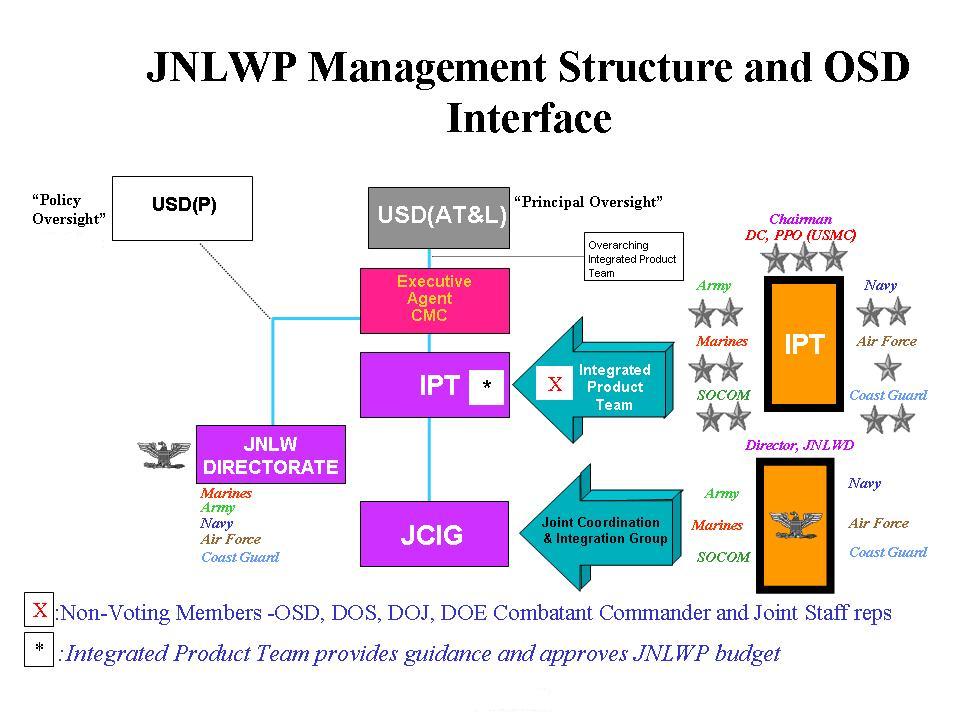
Third, the Joint Non-Lethal Weapons Program brings together weapons scientists from the National Institute of Justice (NIJ), the Department of Justice (DOJ), and all branches of the U.S. military – Army, Air Force, Navy, Marines and Coast Guard. The JNLWP is headquartered at Quantico, VA, home of the FBI training academy. What better place to base an inter-service mind control program?

Fourth, as a joint military-civilian program, the JNLWP provides the perfect means for sharing military weapons technology with law enforcement agencies. The military has no legal right to perform domestic surveillance operations, but the Department of Justice (which oversees the FBI) does. With the help of the FBI and other law enforcement intelligence units, the JNLWP can take military personnel from the Special Operations Division, "sheepdip" them (that is, put them in civilian clothes with valid law enforcement credentials) and send them to work zapping people under the guise of counterintelligence or counterterrorism operations.

Finally, evidence from the open literature suggests that those military scientists most strongly associated with the research of Artificial Telepathy are also very strongly associated with Non-Lethal Weapons. For example, Lt. Col. John Alexander, a man notorious for his telepathy experiments at Psi-Tech, was until 1995 Los Alamos National Laboratory’s manager of non-lethal defense research. He has also been instrumental in organizing three Non-Lethal Weapons conventions. Likewise, Dr. William L. Baker, Chief Scientist at the Directed Energy Directorate of the Air Force Research Laboratory, Kirtland Air Force Base, NM has reported that his lab plans to build anti-personnel weapons based on "cognitive engineering." The result may be a wide range of Non-Lethal Weapons with human effects similar to those associated with Artificial Telepathy.

See David Hambling’s article "Air Force Plan: Hack Your Nervous System" at:
http://www.defensetech.org/archives/002152.html

See Dr. Baker's description of "Controlled Personnel Effects" here:
http://www.afrlhorizons.com/Briefs/Jun04/DE0401.html

"For the Controlled Personnel Effects capability, the S&T panel explored the potential for targeting individuals with nonlethal force, from a militarily useful range, to make selected adversaries think or act according to our needs. . . . By studying and modeling the human brain and nervous system, the ability to mentally influence or confuse personnel is also possible. Through sensory deception, it may be possible to create synthetic images, or holograms, to confuse an individual' s visual sense or, in a similar manner, confuse his senses of sound, taste, touch, or smell."

Dr. Baker’s laboratory, the Air Force Research Laboratory, serves as one of the core research facilities used by the Joint Non-Lethal Weapons Directorate. See their home page:

http://www.afrl.af.mil/

AFRL controls a vast array of exotic laser and microwave weapons, and it has its very own Space Directorate and satellite system. The AFRL’s Directed Energy Directorate has a budget of more than $300 million per year.

In other words, the Joint Non-Lethal Weapons Program could certainly ask AFRL to launch an Artificial Telepathy program, and AFRL has the capabilities to do so.

Friday, January 26, 2007

Artificial Telepathy: A "Non-Lethal" Weapon?

Artificial Telepathy machine cannot possibly be advertised and sold on the open market for obvious reasons: they would utterly destroying the privacy of many, many people. "Peeking" into the lives of others would quickly pervert itself into stalking, mind rape, privacy violation, identity theft and information theft on a massive scale.

Public sale of Artificial Telepathy technology would inevitably result in the stealing of bank account numbers, PIN numbers, passwords, trade secrets, etc., which in turn would inevitably translate into actual theft. The damage to the economy could be catastrophic, and the sudden disappearance of privacy – all privacy – might literally cause society as we know it to melt down.

For all of these reasons, Artificial Telepathy may be rightly called a "non-lethal" H-Bomb. The damage done to society by release of such technology would be nightmarish. See for example the dystopian film Strange Days (1995, starring Ralph Fiennes) in which dream thieves use a technology called "SQUID" to jack into the minds of people, record their experiences, and sell those experiences on disc:

http://en.wikipedia.org/wiki/Strange_Days_(film)

See also the film "Artificial Telepathy" (Dir. Mitchell Cox), from which the movie poster (above) is taken:

http://homepage.eircom.net/~visualaffects/vault/details/15196.html

No one would die as a direct result of the Artificial Telepathy’s use. It is a "non-lethal weapon."
But nothing would ever be the same again.

Most scientists and lawyers understand this. Indeed, if the maker of an Artificial Telepathy weapon tried to sell the product on the open market, the number of people who would line up to sue that manufacturer would probably circle the Earth.

Third in line would be a lawyer representing every voice-hearer and human rights advocate in the Western hemisphere. That’s a large number of people.

Second in line would be a lawyer bringing a massive class-action suit joined by every paranoid corporation that has a trade secret to hide. That is, almost every corporation in the world.

First in line would be the United States government. Every copy of the machine, its blueprints, and its patent documents, would be immediately seized and locked away on the grounds of national security.

The miltary reasons for grabbing up this technology and suppressing it are obvious: With Artificial Telepathy, there is no such thing as a surprise attack. And without the element of surprise, war becomes impossible. Artificial Telepathy machines could potentially put every single G.I. Joe at the DOD out of work. And as far as the Department of Defense is concerned, any technology that puts them out of work is a weapon of mass destruction.

Even if it doesn’t kill anyone.

Translation: No one gets one of these weapons but Uncle Sam. The United States Department of Defense has no objections to weapons of mass destruction. It just objects to anyone else owning one.

Although any government would strictly forbid public ownership of such technology, every government would certainly want to use the Artificial Telepathy machine itself. Far from destroying such a weapon, most military service branches would probably compete for possession of one, as would every law enforcement organization and every intelligence agency under the sun. Some would argue that the machine ought to be destroyed, but others would find that the lure of knowing exactly what the "enemy" is thinking is far too intoxicating to pass up.

An Artificial Telepathy weapon is, after all, a spy agency’s dream.

Conclusion: If or (more properly) when an Artificial Telepathy machine is developed, it will certainly be classified as a weapon – specifically a "Non-Lethal Weapon." It will never be released on the public market. The public will be given no clue that it exists, and the military branches of different countries will fight fiercely among themselves for possession of this cool new toy.

Within the U.S. military branches, the Army, Air Force, Navy and Marines will probably squabble with the intelligence community, law enforcement and the Department of Justice for possession and control, then finally settle on a scheme for sharing control among themselves. Most likely they will combine forces (and budgets) to build and manage new weapons based on the first Artificial Telepathy technology. If the weapons work, everyone will claim to be the proud Papa. If the cover is blown, and Congress launches a massive investigation, the program will be orphaned. Everyone can back off and point fingers at each other.

Joining forces means everyone wins, and nobody is to blame.

Given this conclusion, we can now ask ourselves a simple question: Where would the military hide its deep-black research program into Artificial Telepathy, if such technology exists?

Answer: They would hide Artificial Telepathy under cover of a Joint Non-Lethal Weapons Program.

Question: Does such an organization exist? Answer: Oh yes. See the next post.

Tuesday, January 23, 2007

The Militarization of Neuroscience


When military scientists begin to combine "cognitive engineering" and neuroscience with genetic engineering, we could see a nightmarish new generation of biological weapons and nerve agents that radically alter the minds, emotions, memories and beliefs of everyone on earth.

That's the opinion of Mark Wheelis and Malcolm Dando, authors of "Neurobiology: A Case Study of the Imminent Militarization of Biology" published September 30, 1995 in the International Review of the Red Cross. See this site for a PDF of the full article:

http://www.icrc.org/Web/Eng/siteeng0.nsf/html/review-859-p553


Abstract: The revolution in biology, including advances in genomics, will lead to rapid progress in the treatment of mental illness by advancing the discovery of highly specific ligands that affect specific neurological pathways. The status of brain science and its potential for military application to enhance soldier performance, to develop new weapons and to facilitate interrogation are discussed. If such applications are pursued, they will also expand the options available to torturers, dictators and terrorists. Several generic approaches to containing the malign applications of biology are shown, and it is concluded that success or failure in doing so will be significantly dependent on the active involvement of the scientific and medical communities.

Translation: The medical community has got to stop sitting on its duff and get some international legislation passed prohibiting the development of these bioweapons NOW.

I would add: An equally serious effort needs to be made to block military application of EM weapons to the human brain. The pretence that such weapons are "less than lethal" is a serious misunderstanding of the immense threat that they pose to the privacy and civil liberties of every man, woman and child on the face of the globe.

Saturday, January 20, 2007

1990s: The Decade of The Brain


The military's early mind control research has already been documented in this blog. However, a very important period in the chronology of Artificial Telepathy needs more attention: The 1990s.

Recent efforts by voice-hearers to prove that they are the victims of Artificial Telepathy and other exotic voice-to-skull (V2K) technologies go largely unheeded by the public because most people remain blissfully unaware of the quantum leaps that neuroscience made during the 1990s.

In 1989, President George H.W. Bush declared the 1990s to be the "Decade of the Brain." See:

http://www.loc.gov/loc/brain/

http://en.wikipedia.org/wiki/Decade_of_the_Brain


Just as the United States brought the full force of its scientific community to bear on the problems of splitting the atom in the 1930s and 1940s, so too did the U.S. bring its full force to bear on the problem of penetrating the inner sanctum of the human mind during the 1980s and 1990s. The motive for both research thrusts was much the same: breakthroughs in quantum theory indicated that an extremely important threshhold in our understanding of the way the world works had been reached, and the United States wanted to be the first to cross that threshhold.

For some interesting Wikipedia article on the revolutionary new theories of Quantum Mind and Quantum Brain Dynamics, see these links:

http://en.wikipedia.org/wiki/Quantum_mind

http://en.wikipedia.org/wiki/Quantum_brain_dynamics

Overtly, Quantum Brain theory was presented to the public as an exciting field of investigation, pursued by brilliant professors at various universities, whose goal was to develop "pure and theoretical" knowledge that would be published in the open literature for the benefit of all mankind. Benevolent applications of the resulting neurotechnology might include cures for Alzheimers, epilepsy, schizophrenia, cerebral palsy and Parkinson's. With an amazingly accurate computer map and Quantum model of the brain, the deaf could be made to hear, the blind could be made to see, the mute might be able to talk, and the lame could be helped to walk. New breakthroughs could lead to some amazing medical miracles.

But covertly, the military and its contractors saw in Quantum Brain theory, neural networks and Artificial Intelligence the potential for developing some incredibly powerful and devastating super-weapons. As with most technologies, the resulting neurotechnology could be "dual use." Highly accurate brain maps and supercomputer models that could help and heal people might also be used to control, manipulate and destroy them.

It doesn't take a superbrain to see how much military power lies in the ability to seize remote control of another human's mind.

Controlled Personnel Effects and "Cognitive Engineering"

In his article "Air Force Plan: Hack Your Nervous System", David Hambling provides an interesting overview of how the military plans to use its new brain models for "Active Denial Systems" and "Controlled Personnel Effects." See his article at DefenseTech.org

http://www.defensetech.org/archives/002152.html

The article provides a link to an article titled "Controlled Effects" written by scientists working for the the Air Force Research Laboratory's Directed Energy Directorate (which Hambling refers to as the Air Force "people zapping" unit).

http://www.afrlhorizons.com/Briefs/Jun04/DE0401.html

The Air Force Science & Technology (S&T) panel makes the following statement:

"By studying and modelling the human brain and nervous system, the ability to mentally influence or confuse personnel is also possible. Through sensory deception, it may be possible to create synthetic images, or holograms, to confuse an individual's visual sense or, in a similar manner, confuse his senses of sound, touch, taste or smell. Through cognitive engineering, scientists can develop a better understanding of how an individual's cognitive processes (pattern recognition, visual conditioning, and difference detection) affect his decision-making processes. Once understood, scientists could use these cognitive models to predict a person's behavior under a variety of conditions with the potential to affect an adversary's mission accomplishment via a wide range of personnel effects."

The Air Force S&T panel suggests this technology will be available by 2020. Voice Hearers are saying that it's here now, and it's being used, today. They consider themselves to be the guinea pigs on which these mind-bending weapons are being tested.

If true, this means the U.S. government has deliberately chosen to target and torture its own citizens. The implications are chilling.

In fact, if supercomputer models of the Quantum Brain were combined with "cognitive engineering" and the proper space-based sensors, these weapons offer the power to influence and control the minds of vast numbers of people, both individually and collectively. The political systems and economies of entire countries could be tampered with.

If the same scientists perfect a method to read thoughts remotely, patents and intellectual property could be stolen on a massive scale. No PIN number, account number or secret password would be safe.

The mood of crowds and entire cities could be changed and manipulated. An entire army could potentially be blinded and stopped in its tracks, paralyzed. War plans, orders of battle, and secrets held in the minds of enemy generals and spies could be monitored and plucked with incredible ease, perhaps scrambled or even altered and replanted.

People could be made to walk in front of buses. Normal law abiding citizens could be hypnotized and programmed as assassins. By simply seizing control of the mind of a single man at the control panel of a nuclear missile silo . . . .

Put bluntly: neuroweapons are more powerful than atomic weapons. They threaten to punch a hole in the shield that protects our entire nuclear weapons network. Even nuclear launch codes are not safe from intrusion.

Apparently the Pentagon decided in the 1980s and 1990s that it was imperative that the U.S. military understand "cognitive engineering" and build a new generation of "controlled personnel effects" weapons, before anyone else did. In parallel with the open and overt research performed at universities across the nation, the Defense Department began its own highly classified, covert weapons program, based at military weapons labs and linked to the university system through the Defense Advanced Research Projects Agency (DARPA).

These neuroweapon engineers immediately ran into a problem: how could they get professors and some of the star researchers in the public sector involved? They needed to push the entire field of neuroscience to work faster, they needed a public relations front, and they needed to hook some of the best minds into a new network that would help them siphon off the best research. Result:

The Decade of the Brain.

In early 1989, the United States Congress, by House joint Resolution 174, designated the decade beginning January 1, 1990, as the "Decade of the Brain" and it authorized and requested President George Herbert Walker Bush to issue a proclamation in observance of this occasion.

Joint Resolution 174 became Public Law 101-58, and on 17 July 1989, President Bush issued his proclamation, which launched one of the most massive build-ups in brain research ever undertaken by mankind. The president's proclamation can be found at this link:

http://www.neurolab.jsc.nasa.gov/presproc.htm

Comparing this one-decade, all-out push for brain research to the Manhattan Project or the Apollo space mission to reach the Moon would be very apt. The expenditure was that enormous, and the results of a one-decade effort were indeed amazing. Yet the program received none of the press attention lavished on the Atomic Bomb or the Moon landing, and it fell far short of its stated goal of "conquering brain disease." Schizophrenia, Alzheimer's, Epilepsy, Huntington's Disease, Muscular Dystrophy and other nervous disorders are still very much with us.

What did result from this intensive, one-decade research project?

The public record indicates that several important research programs and networks were established and funded by the National Institute of Health (NIH) and the National Institutes of Mental Health (NIMH). Among the key players:

The Human Brain Project
The International Consortium for Brain Mapping (ICBM)
The Laboratory of Neuroimaging (LONI)
The Biomedical Informatics Research Network (BIRN), and
The Charles A. Dana Foundation

The publicly funded and nonclassified research appears to have been funneled into military labs through the following organizations:

The Defense Advanced Research Project Agency (DARPA)
DARPA's Brain-Machine Interface program
NASA's Neurolab Program, and
The Office of Naval Research (ONR)

Each of these military programs represents an entire network of laboratories, and they will be examined in future posts.

These research programs seem to interconnect in interesting ways with several other organizations strongly associated with telepathy research and the development of exotic technologies:

The Stanford Research Institute (SRI)
Science Applications International Corporation (SAIC)
The Los Alamos National Laboratories (LANL)
Psi-Tech

We will take a closer look at each of these players in future posts to this blogs. The advances in brain mapping achieved by the Human Brain Project are especially worthy of careful attention.

If the testimony of voice-hearers can be believed, the "Decade of the Brain" resulted in weapons with some very, very frightening capabilities.

Wednesday, January 17, 2007

Hearing Voices: Schizophrenia or Artificial Telepathy?


Thought reading at a distance, by a machine? Voices being beamed into the head by satellite?

Innocent victims enduring ritual abuse by thugs working for the military, the NSA, or the CIA?

It all sounds too crazy and sick to be true. It's far easier to believe that people who hear voices are exactly what they seem to be: wackos. In fact, hearing voices remains a classic symptom of schizophrenia, as defined by most textbooks.

Yet a growing body of literature, written by reputable journalists and scientists, gives clear evidence that such technology does exist. See, for example, the books on mind control technology at this excellent website:

MCRAIS The Mind Control and Ritual Abuse Information Service

http://mcrais.googlepages.com/index0.htm

Those who doubt that agents of the U.S. government engage in the torture or "ritual abuse" of American citizens would also do well to read the hundreds of testimonials given by survivors of past experiments. For example, dozens of speeches have been given by survivors at the S.M.A.R.T Ritual Abuse and Mind Control conferences between 1999 and 2006. Transcripts are available on the web:

http://members.aol.com/smartnews/index2.html

Clearly, there is some serious abuse going on. But voice hearers? C'mon. Even among mind control victims, they ain't normal.

Indeed, Voice Hearers face a great hurdle. They must convince skeptics that exotic technologies exists that allow machines to read thoughts. They must prove that voices are being beamed into their heads. They must warn the world of a dangerous new technology that may rape the privacy of every man, woman and child on the planet.

And they've got to do it all without making people laugh them off the stage.

The selection below, from Dorothy Burdick's groundbreaking book "Such Things Are Known" (1982) provides a classic example of a brave "wavie" (a target of voice-to-skull weapons) trying to prove as calmly and reasonably as possible that she is not schizophrenic, even though she hears voices.

Like Cassandra, she bears an important message that no one wants to hear. She knows people would rather kill the messenger (or call her schizophrenic) than listen. Yet she remains honest and objective. She does an outstanding job of researching the technology (as it existed in 1982). She presents persuasive evidence that computers can read minds. And she speaks from the heart, describing vividly what it feels like to be on the receiving end of Artificial Telepathy when the technology is used for mind rape and ritual abuse.

This is one voice that deserves to be heard. -- M


Such Things are Known

Dorothy Burdick
New York: Vantage Press Inc., 1982

Prologue

Reading minds at a distance by deciphering the brain’s magnetic waves has been a project of the Advanced Research Projects Agency [DARPA] of the Defense Department for some time. Many educational and research institutions have contributed to its success with government funding.
Published information indicates that DARPA scientists have learned to identify specific thought patterns through the interpretation of brain waves. These patterns reveal with up to ninety percent accuracy whether a person is: (1) puzzled or uncertain, (2) has made a decision, (3) is paying attention, (4) is observing colors or patterns, or (5) has lost concentration due to fatigue or boredom.

Thought processes have been linked to the computer through Artificial Intelligence [AI]. The autocorrelated Cray, which does one hundred million calculations a second, is specifically designed for problem solving and can carry out biomedical experiments with the computer simulating the human effects. It takes only fifty billionths of a second for an element of data to enter and leave its memory.

Using psychological interviewing techniques. AI has come up with programs which lead the intelligent human to believe that he is talking to another person, when he is actually carrying on a dialogue with a computer. Properly programmed, computers have the capacity to make judgments based on previous performance or experience, predict observed behavior, speech patterns and idiosyncrasies of thought. Computers also convert many types of signals to signs, codes, sound, music and video. Twenty years were spent by Russell Kirsch at the National Bureau of Standards’ Artificial Intelligence Laboratory teaching machines to make judgments called “image pattern recognition.” A well-instructed machine can look at variegated images like brain waves and make decisions concerning them. The marriage of computer programming and brain mapping has been published. To accomplish the wiring and plotting of the functions of the human brain was an incredibly complex task that could only have been accomplished by the invention of the computer itself.

It is known that enough work has been done with large computers and wave averaging on the transmission of neural messages in the brain so that neural activity associated with the word “no” and the word “yes” can be identified whether it is said aloud or not. Near the speech center in the brain is an area that prepares neural messages that drive the muscles associated with speech. Actions of the tongue and mouth and other muscles involved in speech are quite different for these two words. The patterns of nerve signals that go out to make these two words are also unalike. The patterns are formed long before words reach the vocalizing level, and can be read and interpreted in advance of speech by a computer. Pattern recognition computers will read an answer even in a completely uncooperative subject, or specifically read his mind if the thought is mentally put into unspoken words.

Speech is a motor activity which creates electrical signals traveling along neurons. With a computer, these weak signals can be read at a distance by a superconducting quantum interference device (SQUID), which almost completely eliminates environmental noise while magnifying the signal one thousand times over that read by previous technology.

To read the mind, wave analyzers must deal with the complex oscillations of the brain in somewhat the same way that a prism separates the colors of a beam of light. The components of this complex wave are isolated by electronic circuits tuned to several frequencies. Statistical averages can be determined from many readings of the mind under investigation. From this information its versatility and repertoire of adaptive stratagems can be assessed and plotted. This frequency analysis of tactics can now be instantly known and evaluated by computer faster than men can think.

Optical and electronic subsystems for spacecraft and artificial intelligence have been under development since 1955. Sophisticated biomedical sensors have been developed to use on animals at a distance without physical contact. The same equipment has been used to test environmental factors on human sensory organs. Laser is used in biomedical displays to pick up brain signals and convert them to sound and color or even music. With current laser techniques verbal and aural communication is possible between any two points on earth with video and via satellite.

The human head is a target which gives off a magnetic field. Suppose that it is capable of being picked up and locked onto at a distance by a supersensitive sensor many times amplified by optics. Depending upon the kind of ray directed at the head the symptoms and sensations of the subject will vary.

The carotid artery and the hypothalamus are easily reached through the thin wall of the ear drum by sonic and ultrasonic radio waves. Stimuli to this area can raise and lower blood pressure and body temperature. Sensations in other parts of the anatomy are similar to those caused by diathermy depending upon which brain signals are played upon. The subject is literally an instrument who may experience numbness, pain, pleasure, muscle jerks, spasm and stimulation of the sympathetic and parasympathetic nervous system.

It is known that thoughts can be pulsed into the mind through the nervous system by microwaves. This has nothing to do with the auditory nerves. Scientists who have submitted themselves to this process report temporary loss of memory and disorganization of thinking processes.

A subtle method of communication, laser, is used to deliver messages unheard by those close to the receiver. Depending upon the verbal messages received concurrently with physical stimulation, these technological developments become powerful tools combined with psychological techniques to shape, modify, direct, prevent and control human thought and behavior through interference with all known diurnal physiological patterns. Additionally, verbal messages may be delivered at the subliminal level during consciousness and during sleep, so that the subject is unaware that he is receiving them or that his dream sleep is being influenced. Words are emotional triggers. When the subject’s emotional triggers are analyzed he is put in the position of having his thoughts and actions controlled by other individuals. This is mind control.

For at least the last four years every minute of my conscious and unconscious life had been invaded by investigators using state of the art technology. Recently on the “Today Show,” William Colby said that the CIA investigated a device which could read Brezhnev’s mind on his way to work. It is my contention that they not only investigated it but that they made it work.
People have asked me, “What do these voices say?” They say, “We want to be your friends.” As in brainwashing they confuse the issue, and truth becomes obscure. Falsehoods seem reasonable. Indoctrination techniques resemble some techniques used in hypnosis. Like hypnosis they have a soporific effect, reiterating and repeating the same monotonous phrases.

“What you do is up to you. You’ve got to believe in yourself.” This remark is made until you are not really certain whether you know what you want or can rely upon your own opinion.
Pavlov said that a conditioned reflex can be worked out for every stimulus. In brainwashing, brain-changing results. Damage is done to the mind through drugs, hypnotism and other means, so that a memory of what actually happened can be wiped out and a new memory of what never happened inserted. The Voices, by interfering with sleep in a subliminal mode are able to stir up old memories and influence REM Sleep by vocal suggestion. They interfere with normal sleep patterns by inducing physical symptoms which result in jerks, cramps, irritation of the intestinal tract and skin, and in sexual arousal or sudden and unwanted awakening when rest is needed. All the subject is aware of is pain, discomfort, nightmares, unaccountable physical symptoms, fatigue and depression. At other times, he is euphoric with relief.

As in brainwashing, the Voices try to install a feeling of personal satisfaction by making the individual feel that he is needed in some way. The message is combined with physical reinforcement.

“We want you to feel good about yourself.” They specialize in uncertainty. You are always on an up staircase that is going down.

“Dorothy, we don’t know what we are going to do with you.” This comes after occasions of rebuttal, rebellion and general recalcitrance. It may be accompanied by good humor or very unpleasant remarks and physical symptoms.

In the beginning, although one is not incarcerated except mentally and environmentally, the subject feels dreadfully tired and worn out. Returning POWs describe it as being like an automaton or going about in a daze.

The Voices use suggestive interrogation with desired answers implied in the wording. They alternate this with a barrage of denunciation and accusation to make you cringe. The more tired you are, the more it upsets you. They excavate the psyche for areas of sensitivity involving social attitudes, sex, marital and family relationships and feelings about self. Any vulnerability will do, and all the time, fatigue both physical and mental, is working for them. The more sensitive and reasonable the individual, the more vulnerable they are. Pushovers for indoctrinators are very intelligent but uneducated, especially the indecisive minds that always see some valid point in the other side's argument.

The victim’s feeling is that his thinking is being directed. The brainwasher has been called a corticovisceral psychiatrist, able to interfere with the normal path that every human follows in life. Such a Voice directs or suggests to the subject a new route leading off in an entirely new direction. Conflicts arise in anyone between known emotional responses and those of which he is unaware and which are suppressed. No one actually knows or realizes what is going on in his own subconscious mind. The Brainwasher Voice is trained to increase such conflict and to manipulate these responses.

A great effort is made to arouse guilt feelings. Failures to meet a standard of achievement or conduct are used frequently as guilt stimuli. A decided effort is made to uncover normal failings and to take advantage of them in order to hammer them into a guilt complex. No matter how guilt arises, it is necessary to the Voice Indoctrinator for projection purposes.

The Brainwasher Voice continually attempts to sow doubt in the mind of the subject. Regardless of the strength of conviction of the individual so attacked, the moment doubt clouds the mind, it leads to tension. Tension is related to fear, and guilt also produces fear.

They asked me, "What do you want lo do?" My answer was that I wanted to survive. Fear itself is an expression of unsatisfied need for survival and security. First reactions are nervousness, tension, apprehension and depression. They make the need for security and self-protection even more acutely felt.

Fortunately for me none of this was done in a really controlled environment, yet my privacy in all things was gone and I was isolated from human intercourse because nobody could believe that the Voices I heard were anything but inventions of my subconscious.

As a result of these artificially induced pressures including chronic fatigue, I was deprived of strength to combat repetitious suggestions and started to doubt my own thoughts and convictions.

Suppose in this condition that ideas are suggested at a subconscious level, not positive suggestions used in department store tapes to prevent stealing, but destructive behavioral ideas that will result in a poorer self-image, lowered confidence, both physical and mental, and atypical behavior. The suggestions assume a symbolic significance to the individual. Suppose the assault on the mind, body and nervous system is continual over a twenty-four hour period seven days a week. In this state one begins to live in a realm of fantasies and false beliefs. In the hands of Brainwasher Voices and technologists with Space Age Tools, anyone is malleable. An illusory, surreal, invisible environment is created, real only to the victim.

In a prison camp one can make up one’s mind not to listen. There are other prisoners. As a laser receiving station in your own home and environment one has to listen involuntarily and still try to act normally, perform tasks, drive a car and do routine things as much as possible. The incarceration is real, but unseen.

The tools of mind attack include suggestion, mockery, fear, fatigue, deception and manipulation. As in brainwashing, the Voice sometimes begins with ideas and ideals with which the recipient can agree. The only relief from tension in this insidious process is laughter or drugs like sleeping pills and alcohol. The receiver forgets that he is the one who is suffering from fear, uncertainty, browbeating and the invasion of privacy in sex, toilet and social relationships. When he most fears for public performance and they let up, he feels grateful for no reason at all.

All these things are known to government psychiatrists and psychologists. The government in question is the government of the United States of America. The events I recount began on a May weekend in 1978. ...

Sunday, June 18, 2006

The Aviary: Key players of the 1980s and 1990s


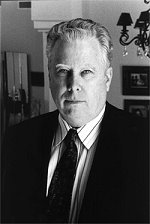
The story of artificial telepathy research in the 1980s and 1990s centers on The Aviary and their leader, Col. John B. Alexander (see photo).

"The Aviary" is a collection of strange birds: a group of key scientists, military men and intelligence agents who share an intense interest in UFOs, telepathy, remote viewing, parapsychology, mind control and the creation of psychotronic weapons.

They seem to work and flock together, and they are reportedly part of a secretive cell. Its members are codenamed after birds, hence they are called "the Birds" and their cell is called the "Aviary."

See: http://www.think-aboutit.com/ufo/aviary.htm
http://www.drboylan.com/aviary2.html

The strange UFO slant on this group appears to be simple disinformation.

Members of the Aviary have reportedly participated in MILABS operations -- black operations by rogue military-intelligence units that stalk, harrass, terrorize, kidnap, drug, gang-rape and mind-rape innocent civilians, using hypnotic mind-control programming to implant a false post-hypnotic "memory" that the episode was an "alien abduction."

See Dr. Richard Boylan's article on Fake "Alien abductions":
http://www.drboylan.com/milabs.html

A well-designed program to torture civilians requires plausible deniability and a built-in means or method to discredit the victims. Certainly people who hear voices or run to the police complaining of an "alien abduction" are instantly discredited. Hence the UFO debate: are alien abductions real, or just some kind of psywar cover for nefarious deeds by "men in black"?

For John Alexander's comments on MILABS, and his plausible denial that any such program exists, see: http://www.konformist.com/mkkafe/milabs.htm
For Alex Constantine's rebuttal:
http://www.konformist.com/mkkafe/milabsa.htm
For Armen Victorien's comments:
http://www.konformist.com/mkkafe/milabsb.htm

According to the Doc Hambone site
http://www.mindcontrolforums.com/hambone/people.html
there is still a great deal of uncertainty over who belongs to the Aviary, and what their codenames really are:

"The individuals involved expanded to include almost anyone that supports or debunks UFO research that is in any way connected to the government. Michael Persinger has been included, as well as Susan Blackmore for interviewing him. It has degenerated to the point that it's now an inside joke on the newsgroups, with people giving each other codenames like Pigeon and Dodo Bird."

The Aviary in Order of Codename:

BLUEJAY - Dr Chris Green - CIA.

CHICKADEE - Cmdr. C.B. Scott Jones - psychotronics, Navy Intel, DIA

CONDOR - Capt. Bob Collins, USAF

HAWK - Ernie Kellerstraus

FALCON - Sgt. Richard "Dick" Doty

MORNINGDOVE - Unnamed

OWL - Dr Harold Puthoff – Parapsychologist, Ex NSA

PARTRIDGE - Jacques Vallee, PhD

PELICAN - Ron Pandolphi – Physicist CIA

PENGUIN - John Alexander - Former Army Intel on the board of Psi-tech

RAVEN - Dr Jack Vorona – DIA DoD

SEAGULL - Bruce Maccabee, Ph.D.

SPARROW - William Moore, USAF


The Aviary in order of real name:

COL. JOHN B. ALEXANDER - Penguin

CAPT. BOB COLLINS - Condor

SGT. RICHARD "DICK" DOTY - Falcon

Dr. CHRISTOPHER GREEN - Bluejay

C.B. SCOTT JONES - Falcon or Chickadee

ERNIE KELLERSTRAUS - Hawk

BRUCE MACCABEE - Seagull

WILLIAM MOORE - Sparrow

RON PANDOLFI - Pelican

DR. HAL PUTHOFF - Owl

JACQUES VALEE - Partridge

JACK VORONA - Raven

The following are short profiles of the reported members of The Aviary.

John Alexander (PENGUIN), Ph.D. in Thanatology [Death Sciences], Col. ("Ret."), U.S. Army Intelligence and Security Command (INSCOM), which is undoubtedly his military cover for the National Security Agency (NSA). He is a former Green Beret, and completed his Ph.D. thesis under the supervision of Elizabeth Kubler-Ross, an expert in "out of body" experiences during near-death trauma.

He entered the Army as a private in 1956, and retired as a Colonel in 1988. Commander, Army Special Forces Teams, U.S. Army, Thailand, Vietnam, 1966-69. Chief of Human Resources division, U.S. Army, Ft. McPherson, GA, 1977-79. Inspector General, Department of the Army, Washington, 1980-82. Chief of human technology, Army Intelligence Command, US Army, Arlington, VA 1982-83. Manager of tech integration, Army Materiel Command, US Army, Alexandria, VA, 1983-85. Director, advanced concepts, US Army Lab Command, Adelphi, MD, 1985-88.

In December 1980, Colonel Alexander published an article in the US Army's journal, Military Review, "The New Mental Battlefield", stating that telepathy could be used to interfere with the brain's electrical activity. This caught the attention of senior Army generals who encouraged him to pursue what they termed "soft option kill" technologies. After retiring from the Army in 1988, Alexander joined the Los Alamos National Laboratories (LANL) and began working with Janet Morris, the Research Director of the US Global Strategy Council (USGSC), chaired by Dr Ray Cline, former Deputy Director of the CIA.

As director of the Non-Lethal (sic) Weapons Department at LANL, Alexander has been reportedly involved in counter-intelligence remote-viewing, psychic-warfare, psychotronic and mind-control projects with military/security applications, while maintaining the cover of nonlethal military/crowd control physical-countermeasures research.

Along with INSCOM General Al Stubblebine and INSCOM Major Ed Dames, Dr. Alexander has been serving as a Board Member of PSI-Tech Corporation, involved in proprietary remote-viewing projects for hire.

According to the National Institute of Discovery Science (NIDS), a Department of Defense funded think tank which explores so-called fringe science and psychology, Dr. John B. Alexander serves as a "Discreet Project Scout."

NIDS states: "Dr. Alexander, a staff member of the National Institute of Discovery Science, provides interface with Science Advisory Board Members. He joined NIDS when it was formed in 1995 shortly after retiring (a second time) from the University of California. . . . Dr. Alexander was chairman of the first three major US conferences on non-lethal weapons. His work has brought him international recognition and he has been a US delegate to three NATO studies on advanced weapons. He has written many articles on a wide variety of topics and co-authored The Warrior’s Edge. "

The Penguin also serves on the adjunct faculty of the California Institute for Human Sciences. http://www.cihs.edu/

Rumor has it that Alexander is head of the Aviary, and that the Aviary is headquartered at Los Alamos.

Victorian, Armen "Nonlethality: John B. Alexander, The Pentagon's Penguin" Lobster, June 1993 http://home.earthlink.net/~alanyu76/nonlethal.htm

See Also: The Three Faces of the Penguin http://www.konformist.com/1998/penguin/penguin.htm

Chart regarding the many connections of John B. Alexander:
http://www.namebase.org/cgi-bin/nb06?_ALEXANDER_JOHN_B%20%28COL%29

For many more sources, try searching on the string "Alexander, John B." at Namebase:
http://www.namebase.org/n2search.html

Capt. Robert M. "Bob" Collins (CONDOR), USAF (Ret.), Special Agent, Air Force Office of Special Investigations, engaged in UFO-related intelligence operations; reportedly appeared clandestinely on 1988 Kodak-produced network television (dis-)information program "UFO Cover-Up Live", where Collins, *reportedly* along with "former" CIA contract employee and current UFO-conferences disinformation lecturer, John Lear, presented accounts of alien autopsies, UFO retrievals, and the government's awareness about UFOs and ET presence.

See Also: http://www.namebase.org/cgi-bin/nb01?Na=Collins%2C+Robert+M.

Sgt. Richard C. "Dick" Doty (FALCON), USAF (Ret.), Special Agent, Air Force Office of Special Investigations, reported to have engaged in UFO disinformation projects, including reportedly hoaxing TV producer Linda Moulton Howe concerning availability of a tape showing a UFO landing at Holloman Air Force Base, NM; and of allegedly waging psychological warfare on Albuquerque defense electronics contractor Paul Bennewitz, concerning Bennewitz's electronic monitoring of UFO activity around Kirtland AFB/Sandia National Laboratories, Albuquerque, reportedly causing/exacerbating a mental breakdown in Mr. Bennewitz. Reportedly, FALCON claims to have seen the Roswell Alien Autopsy film (shown worldwide August 28, 1995) some time ago at Los Alamos National Laboratory.

See Also: http://www.namebase.org/cgi-bin/nb01?Na=Doty%2C+Richard

Dr. Christopher C. "Kit" Green (BLUEJAY), MD, Ph.D., Chief, Biomedical Sciences Department, General Motors; former custodian of the CIA's UFO files at the "Weird Desk"; received the National Intelligence Medal for his work on a classified project during the period of 1979-1983; recently reported to be White House UFO liaison. Dr. Green has admitted that the CIA has compiled over 30,000 files on UFOs, 200 of which are extremely interesting. Green was a key CIA member in examining the UFO problem for several years: a former Scientific Advisor on the Advisory Board to the Directorate of Intelligence, CIA. He apparently has interests that extend into remote viewing, neurophysiology, and other highly interesting areas. Known for his stony silence.

See Also: http://www.namebase.org/cgi-bin/nb01?Na=Green%2C+Christopher

Cmdr. C.B. Scott Jones (CHICKADEE), Ph.D., USN (Ret.), former officer with the Office of Naval Intelligence and other Agencies; with 30 years service in U.S. Intelligence overseas; involved in government research and development projects for the Defense Nuclear Agency (DNA), Defense Intelligence Agency (DIA), Defense Advanced Research Projects Agency (DARPA), the Army Intelligence and Security Command (INSCOM) and other organizations; former Senate aide to Sen. Claiborne Pell, who has had a long-standing interest in UFOs and the paranormal, *and has tried to get Congressional Hearings held on UFOs; President, Human Potential Foundation; and "point-man" for Laurence Rockefeller on UFO matters, currently tasked to contact world leaders concerning upcoming public announcements of UFO/ET reality; recently convened the May, 1995 Washington, D.C. "When Cosmic Cultures Meet International Conference."

See Also: http://www.namebase.org/cgi-bin/nb01?Na=Jones%2C+Scott

Ernie Kellerstraus (HAWK), security-cleared for UFO information, worked at Wright-Patterson AFB in the 1970's, and is reported to have lived with a Star Visitor for a while; reported to have worked with Dale Graff (*HARRIER*?) and Captain Bob Collins (CONDOR), Air Force Intelligence, to supply UFO information to widely-suspected disinformation operative and self-styled ufologist William Moore.


Bruce Maccabee (SEAGULL), Ph.D., research scientist in optical physics and laser weapons applications at the U.S. Naval Surface Weapons Lab, MD; MUFON physics/photo-interpretive consultant, and prolific author and consultant expert on selected "leaked" or disinformational UFO cases/topics, such as the Gulf Breeze-Ed Walters alleged UFO photos, the Canadian "Carp UFO" hoaxed "incident", and the documented repeat UFO landings at the hyper-secure Manzano Canyon Facility at Kirtland AFB/Sandia National Laboratories-Military Reservation.

http://www.namebase.org/cgi-bin/nb01?Na=Maccabee%2C+Bruce

William L. Moore (SPARROW), USAF (Ret.), Special Agent, Air Force Office of Special Investigations; prolific UFO "author"; reportedly publicly admitted at a MUFON Conference to being an Air Force Intelligence operative involved in UFO-related disinformation projects.

http://www.namebase.org/cgi-bin/nb01?Na=Moore%2C+William+L.

Ronald Pandolfi (PELICAN), CIA Deputy Director for the Division of Science and Technology, and current custodian of UFO files at the "Weird Desk"; involved in the White House Initiative, as UFO liaison, to expedite (at Laurence Rockefeller's behest) the release of UFO information to the public; and has been quietly leaking UFO information the past few years.

See Also: http://www.namebase.org/cgi-bin/nb01?Na=Pandolfi%2C+Ron

Harold E. "Hal" Puthoff (OWL), physicist with the Institute for Advanced research in Austin, TX who specializes in Zero-Point Energy, a quantum/resonance physics phenomenon with reported potential for above- unity ("free") energy; formerly an Stanford Research Institute (SRI) and reported DIA researcher, (along with psi guru and fellow Scientologist Ingo Swann,) into parapsychological, psychotronic, remote-viewing, and mind-control projects, and reportedly involved in classified ET-technology studies.

See Also: http://www.namebase.org/cgi-bin/nb01?Na=Puthoff%2C+Harold

Jacques Vallee (PARTRIDGE), Ph.D., formerly an astrophysicist with GEPAN, the French Goverrnment's UFO investigative agency, later moved to U.S. as principal investigator with Defense Department computer network projects; worked with famed astronomer Dr. J. Allen Hynek who left and denounced the military's Project Blue Book as a disinformational smokescreen; prolific author on UFO subject, lately turning to metaphysical explanations for the phenomenon.

See Also: http://www.namebase.org/cgi-bin/nb01?Na=Vallee%2C+Jacques

Dr. Jack Vorona (RAVEN) one of the initiators of the DIA's Sleeping Beauty project which aimed to achieve battlefield superiority using mind-altering electromagnetic weaponry; Appears to be a kingpin in The Aviary, and a Washington insiders' guessing game has sprung up, as devotees of UFO intelligence data argue for the probable identity of their favorite "candidate". [Possible candidates: Henry Kissinger, Ph.D., Edward Teller, Ph.D.; General Brent Scowcroft.]

See Also: http://www.namebase.org/cgi-bin/nb01?_VORONA_JACK_

Sunday, June 11, 2006

History of Artificial Telepathy, 1950 - Present


1950s

Exploration of Remote Mind Control methods began in the 1950's. From this point onward, experiments in telepathy and remote mind control ("artificial telepathy") began to overlap.

In 1952, the CIA began Project Moonstruck. Electronic devices were designed to be implanted in the brain or teeth, surreptitiously or during abduction, with the specific goal of mind and behavior control.

In 1953, the agency launched Project MK-ULTRA, also known as Project Artichoke, an umbrella program with many sub-programs. Psychiatrists experimented with drugs, narcoleptic trance, electronics, and electroshock to create "cyborg" mentalities. The experiments involved "remote control" insofar as VHF, UHF and modulated ELF broadcasts were used for E.D.O.M. (Electronic Dissolution of Memory).

The Soviets reportedly began to delve into the biological effect of microwaves as early as 1953. A number of laboratories were set up across the Soviet Union and in Eastern Europe, including one at the Institute of Hygiene and Occupational Diseases Academy of Medical Sciences.

Although the Soviets reported on their experiments in the open literature, the parameters they defined were insufficient for duplicating the experiments, and some scientists in the United States questioned whether the whole matter was disinformation. It was not.

Early CIA funding provided the wherewithal for a project launched at Honeywell, Inc. for "a method to penetrate inside a man's mind and control his brain waves over long distance."

At the National Institutes of Health, Dr. Maitland Baldwin, under CIA supervision, bombarded the brains of lobotomised monkeys with radio waves. According to researcher Alex Constantine, "His CIA monitors noted weird excesses: in one experiment, Baldwin decapitated a monkey and transplanted its head to the body of another, then attempted to restore it to life with radar saturation."

In his pioneering work, Dr. Ross Adey determined that emotional states and behavior can be remotely influenced merely by placing a subject in an electromagnetic field. By directing a carrier frequency to stimulate the brain and using amplitude modulation to shape the wave to mimic a desired EEG frequency, he was able to impose a 4.5 CPS theta rhythm on his subjects.

Meanwhile, experiments in classic telepathy continued.

In 1953, Wilfred Daim, an Austrian psychotherapist, attempted to transmit a target to a sleeping percipient. The target material consisted of a geometrical symbol and a color in random combination. Target-dream correspondences were reported in 75% of 30 trials.

At about the same time, exploratory dream telepathy studies were being initiated by Montague Ullman and L.A. Dale. These studies were designed to explore possible paranormal correspondences between recorded dreams and events in each of their lives.

The results were encouraging and led to a series of exploratory studies using the all-night REM monitoring technique to determine the onset and termination of recurring dream sequences. This technique freed the investigator from relying on the uncertainty of spontaneous dream recall in a dream telepathy experiment.

These studies pointed to the usefulness of the REM monitoring technique as a way of experimentally approaching the subject of dream telepathy. The results supported the working hypothesis that psi effects could be incorporated into both manifest and symbolic dream content. Further refinement of the design was indicated:

1. To eliminate all possibilities of sensory cues relating to the target reaching the subject.
2. To arrange for the independent blind outside judging of possible corre­spondences between target and dream.
3. To work out appropriate statistical techniques to evaluate any matching process.

In 1962, with the establishment of a Dream Laboratory at Maimonides Medical Center in Brooklyn, it became possible to pursue the work along these lines.

The telepathy research at Miamonedes Medical Center was later incorporated into the CIA’s MONARCH program. The apparent goal was to somehow combine telepathy with remote mind control.

Sources:

Dale, L. A. A series of spontaneous cases in the tradition of Phantasms of the Living. Journal of the American Society for Psychical Research, 45: 85-101, 1951.

Aserinsky, E., and Kleitman, N. Regularly occurring periods of eye motility and concomitant phenomena during sleep. Science, 118: 273-274, 1953.

Daim, W. Studies in dream-telepathy. Tomorrow, 2: 35-48. 1953.

Ehrenwald, J. (1955). New Dimensions of Deep Analysis. New York: Grune & Stratton.

Servadio, E. A. (1956). Transference and thought transference. International Journal of Psychoanalysis, 37: 392-395.

Rose, R. Living Magic: The Realities underlying the Psychical Practices and Beliefs of Australian Aborigines. Chicago: Rand McNally, 1956.

Coleman, M. L. The paranormal triangle in analytical supervision. Psychoanalysis and the Psychoanalytic Review, 45: 73-84, 1958.

1960

The CIA launched MK-DELTA, known as "Deep Sleep," a remote mind control program focussed on fine-tuned, electromagnetic subliminal programming. The agency used VHF, HF, and UHF transmissions modulated at ELF to cause fatigue, mood swings and behavior dysfunction in chosen targets.

Drs. Joseph Sharp and Allen Frey experimented with microwaves seeking to transmit spoken words directly into the audio cortex via a pulsed-microwave analog of the speaker's sound vibration. Indeed, Frey's work in this field, dating back to 1960, gave rise to the so called "Frey effect" which is now more commonly referred to as "microwave hearing." Within the Pentagon this ability is now known as "Artificial Telepathy."

Adey and others have compiled an entire library of frequencies and pulsation rates which can effect the mind and nervous system.

1961

In 1961, Allen Frey, working for the Defense Intelligence Agency (DIA), announced that human beings are capable of hearing microwave broadcasts, in the case of his experiments, what he described as buzzing or knocking sounds.

1962

By the 1960s, many telepathy researchers had become dissatisfied with the forced-choice experiments of J. B. Rhine, partly because of boredom on the part of test participants after many repetitions of monotonous card-guessing, and partly because of the observed "decline effect" where the accuracy of card guessing would decrease over time for a given participant, which some parapsychologists attributed to this boredom.

Some parapsychologists turned to free response experimental formats where the target was not limited to a small finite predetermined set of responses (e.g., Zener cards), but rather could be any sort of picture, drawing, photograph, movie clip, piece of music etc.

As a result of surveys of spontaneous psi experiences which reported that more than half of these occurred in the dreaming state, researchers Montaque Ullman and Stanley Krippner at the Maimonides Medical Center in Brooklyn, New York, undertook a series of experiments to test for telepathy in the dream state.

A "receiver" participant in a soundproof, electronically shielded room would be monitored while sleeping for EEG patterns and rapid eye movements (REMs) indicating dream state. A "sender" in another room would then attempt to send an image, randomly selected from a pool of images, to the receiver by focusing on the image during the detected dream states. Near the end of each REM period, the receiver would be awakened and asked to describe their dream during that period. The researchers claim that the data gathered suggest that sometimes the sent image was incorporated in some way into the content of the receiver's dreams.

Sources:

Ullman, M., Krippner, S., and Feldstein, S. Experimentally-induced telepathic dreams: Two studies using EEG-REM monitoring technique. International Journal of Neuropsychiatry, 2: 420-437, 1966.

Ullman M., and Krippner, S. A laboratory approach to the nocturnal dimension of paranormal experience: Report of a confirmatory study using the REM monitoring tech­nique. Biological psychiatry, 1: 259-270, 1969.

Ullman, M., and Krippner, S. Dream studies and telepathy. Parapsychological Monographs No. 12. New York: Parapsychological Foundation, 1970.

Ullman, M., Krippner, S., and Honorton, C. A review of the Maimonides dream-ESP experiments, 1964-1969. Psychophysiology, 7: 354-355, 1970 (a) (abstract).

Ullman. M.. Krippner, S., and Honorton, C. A review of the Maimonides dream-ESP experiments 1964-1969. Mysterious Worlds (Tel Aviv), 16: 36-37, 1970 (b).

Ullman. M., and Krippner, S., with Vaughan, A. Dream Telepathy. New York: Macmillan, 1973.

1964

In 1964, CIA Director Richard Helms sent a memo to the Warren Commission, mentioning "biological radio communication." Helms' theorising about such methods was truly reminiscent of Orwell's 1984. He said, "Cybernetics [or computer theory] can be used in the moulding of a child's character, the inculcation of knowledge and techniques, the amassing of experience, the establishment of social behaviour patterns -- all functions which can be summarised as control of the growth processes of the individual."

1965

From 1965 through to 1970, the Defense Advanced Projects Research Agency (DARPA), with up to 70-80% funding provided by the military, set in motion operation PANDORA to study the health and psychological effects of low intensity microwaves with regard to the so-called "Moscow signal."

This project appears to have been quite extensive and included (under U.S. Navy funding) studies demonstrating how to induce heart seizures, create leaks in the blood/brain barrier and production of auditory hallucinations.

Despite attempts to render the Pandora program invisible to scrutiny, FOIA filings revealed memoranda of Richard Cesaro, Director of DARPA, which confirmed that the program's initial goal was to "discover whether a carefully controlled microwave signal could control the mind." Cesaro urged that these studies be made "for potential weapons applications."

Duane, D. & Behrendt, T. (1965). Extrasensory electroencephalographic induction between identical twins. Science, 150, 367.

1971

A telepathic experiment conducted during the Apollo 14 mission in 1971 proved distance is not a barrier. The experiment was not authorized by the National Aeronautics and Space Administration (NASA), nor was it announced until the mission was completed. Astronaut Edgar D. Mitchell conducted the experiment with four recipients on Earth, 150,000 miles below. Mitchell concentrated on sequences of twenty-five random numbers. He completed 200 sequences. Guessing 40 correctly was the mean chance. Two of the recipients guessed 51 correctly. This far exceeded Mitchell's expectations, but still was only moderately significant.
Ganzfeld experiments have received widespread attention in recent times, and some believe they provide some experimental evidence of telepathy[citation needed]. Such experiments, however, are generally believed to be flawed by the scientific community.[1][2]

Other experiments have been conducted by the biologist Rupert Sheldrake, who claims strong results. These include experiments into:

The 'sense of being stared at', in which the subject guesses whether he/she is being stared at by another person
Whether a subject can tell who is phoning them before picking up the receiver
Whether dogs can tell when their owners are about to return home.

1973

In 1973, Dr. Joseph C. Sharp, at Walter Reed Hospital, while in a soundproof room heard spoken words broadcast by "pulsed microwave audiogram." Broadcast in a range between 300 MHz to 3GHz. Sharp was able to identify words that were broadcast without any form of electronic translation device - by direct transmission to the brain.

L.L. Vasiliev, professor of physiology at the University of Leningrad, described one experiment in remote hypnosis using undefined techniques of radio control:

"As a control of the subject's condition, when she was outside the laboratory in another set of experiments, a radio set was used. The results obtained indicate that the method of using radio signals substantially enhances the experimental possibilities. I.F. Tomaschevsky [a Russian physiologist] carried out the first experiments with this subject at a distance of one or two rooms, and under conditions that the participant would not know or suspect that she would be experimented with. In other cases, the sender was not in the same house, and someone else observed the subject's behaviour. Subsequent experiments at considerable distances were successful. One such experiment was carried out in the park at a distance. Mental suggestions to go to sleep were complied with within a minute."

1974

In 1974, Lawrence Pinneo, a neurophysiologist and electronic engineer working for Stanford Research Institute (a leading military contractor), "developed a computer system capable of reading a person's mind. It correlated brain waves on an electroencephalograph with specific commands."

J.F. Schapitz, working with the Department of Defense in 1974, filed the following research proposal:

"In this investigation it will be shown that the spoken word of the hypnotist may be conveyed by modulated electro-magnetic energy directly into the subconscious parts of the human brain - i.e., without employing any technical devices for receiving or transcoding the messages and without the person exposed to such influence having a chance to control the information input consciously."

Schapitz proposed an experiment wherein a subject would be subconsciously told to leave the laboratory, the command triggered by a word or action from the researcher. As in the tricks played by stage hypnotists, Schapitz was certain that the subject would rationalise the otherwise irrational desire to leave the lab. Records of Schapitz' research, beyond the initial proposal, have never been declassified.

A specific Russian mind control technology was outed by the American Defense News in 1993, termed "acoustic psycho-correction." According to the magazine, "The Russian capability, demonstrated in a series of laboratory experiments dating back to the mid-1970s, could be used to suppress riots, control dissidents, demoralise or disable opposing forces and enhance the performance of friendly special operations teams, sources say.

"Pioneered by the government-funded Department of Psycho-Correction at the Moscow Medical Academy, acoustic psycho-correction involves the transmission of specific commands via static or white noise bands into the human subconscious without upsetting other intellectual functions. Experts said that laboratory demonstrations have shown encouraging results after exposure of less than one minute."

Targ, R. & Puthoff, H.E. (1974). Information transmission under conditions of sensory shielding. Nature 252, 602-607.

1975

A study by A.W. Guy and others, released in 1975 by the DIA, reported on experiments to determine the particulars of the phenomenon of audible electromagnetics, and its relation to such things a pulse power, pulse shape, and frequency. Along with a number of details about the nature of electromagnetic interaction with humans and animals. Guy explained why the microwaves were audible: microscopic thermal expansion of brain tissues. Guy had even experimented with sending Morse code via microwaves.

Also reported on were Soviet capabilities: "Sounds and possibly even words which appear to be originating intercranially can be induced by signal modulations at very low power densities."

Dr. Robert O. Becker, in The Body Electric, commented on the technology: "Such a device has obvious applications in covert operations designed to drive a target crazy with 'voices' or deliver undetected instructions to a programmed assassin."

1976

EDWIN MAY joined the Stanford Research Institute's remote viewing program in 1976. He became head of the program after Hal Puthoff left in 1985. He continued his work as director at SAIC (Science Applications International Corporation) when the research program moved in 1991.

May left SAIC on 11/28/95. He is a frequent contributor to the Journal of Parapsychology, and is currently with the Cognitive Sciences Laboratory of Palo Alto, California, which he founded at SRI.

Puthoff, H. E. & Targ, R. (1976). A perceptual channel for information transfer over kilometer distances: Historical perspective and recent research. Proc. IEEE, 64, 329-354.

1977

Dr. Sidney Gottlieb, the MKULTRA heavyweight, during questioning by Senator Richard Schweicker in 1977 Senate hearings on CIA drug testing responded as follows:

SCHWEIKER: Some of the projects under MKULTRA involved hypnosis, is that correct?
GOTTLIEB: Yes.
SCHWEICKER Did any of these projects involve something called radio hypnotic intracerebral control, which is a combination, as I understand it, in layman's terms, of radio transmissions and hypnosis.
GOTTLIEB: My answer is "No."
SCHWEICKER: None whatsoever?
GOTTLIEB: Well, I am trying to be responsive to the terms you used. As I remember it, there was a current interest, running interest, all the time in what effects people's standing in the field of radio energy have, and it could easily have been that somewhere in many projects, someone was trying to see if you could hypnotise someone easier if he was standing in a radio beam. That would seem like a reasonable piece of research to do.

In 1977 Dr. Sam Koslov, the scientific assistant to the Secretary of the Navy, was briefed on a number of current research projects. One of them, in progress at Stanford Research Institute was named "ELF and Mind Control." ELF is the acronym of extremely low frequency electromagnetic radiation. Koslov didn't like the sound of that project and ordered it cancelled, but according to the Washington Post, the funding was merely diverted into a different project heading and continued to go forward.

1978

From 1978 to 1988, Skip Atwater was the Operations and Training Officer for the once highly classified US Army Intelligence remote viewing surveillance program, and played an important role in the program’s founding. Working closely with the personnel in the SRI International remote viewing research program, he trained professional intelligence personnel to remote view, then used these highly skilled psychic spies to conduct thousands of remote viewing intelligence collection missions for a variety of US intelligence agencies. For ten years Skip worked directly with the cadre of remote viewers, helping to hone their skills.

Since his military retirement in 1988, Skip has been the Research Director at The Monroe Institute, a world renowned nonprofit organization conducting research and offering educational programs supporting the evolution of consciousness. He has published technical research on methods for expanding consciousness, and assisted hundreds of individuals in experiencing and exploring altered states of consciousness. is a director on the board of the International Remote Viewing Association.

1981

Scientist Eldon Byrd, who worked for the Naval Surface Weapons Office, was commissioned in 1981 to develop electromagnetic devices for purposes including riot control, clandestine operations and hostage removal.

1983

Major Edward Dames claims he was the operations and training officer for the Army's (INSCOM) and DIA's remote-viewing program starting around late 1983 under CENTER LANE. "Dames took a 'let's see what this baby can do' approach, replacing the unit's former intelligence collection methodology with the breakthrough technique.

He left the remote-viewing unit in late summer, 1988.

Dames was a long-serving member of the highly classified operation GRILL-FLAME, a program that focused on some of the more bizarre possibilities of intelligence gathering and remote interrogation. Known as "remote viewers," GRILL-FLAME personnel possessed a marked psychic ability that was put to use "penetrating" designated targets and gathering important intelligence on significant figures.

The program operated with two teams: one working out of the top secret NSA facility at Fort George Meade in Maryland, and the other at Stanford Research Institute. Results are said to have been exemplary.

1989

Following the Oliver North debacle, the Secretary of Defense officially terminated GRILL-FLAME, fearing bad publicity if the program were to become known to the public. The leading members of the project -- including Dames -- immediately relocated to the privately owned and newly formed Psi-Tech, in Beverly Hills, CA.

They continue their work to this day, operating under government contract. In the course of his work, Dames was (and remains) close to many the leading figures and proponents of anti-personnel electromagnetic weapons, especially those that operate in the neurological field.

During NBC's "The Other Side" program, Dames stated that "The U.S. Government has an electronic device which could implant thoughts in people." He refused to comment further. The program was broadcast during April 1995.

Radin & Nelson, 1989;

Radin, D. I. & Nelson, R. D. (1989). Evidence for consciousness-related anomalies in random physical systems. Found. Phys. 19(12), 1499-1514.

March 1991

The March 23, 1991 ITV newsbrief "High-Tech Psychological Warfare Arrives in the Middle East"describes a US PsychologicalOperations (PsyOps) tactic directed against Iraqi troops in Kuwait during Operation Desert Storm. The manoeuvre consisted of a system in which subliminal mind-altering technology was carried on standard radio frequency broadcasts.

The March 26, 1991 newsbrief states that among the standard military planning groups in the centre of US war planning operations at Riyadh was "an unbelievable and highly classified PsyOps program utilising 'silent sound'techniques."

The opportunity to use this method occurred when Saddam Hussein's military command-and-control system was destroyed. The Iraqi troops were then forced to use commercial FM radio stations to carry encoded commands, which were broadcast on the 100 MHz frequency. The US PsyOps team set up its own portable FM transmitter, utilising the same frequency, in the deserted city of Al Khafji. This US transmitter overpowered the local Iraqi station. Along with patriotic and religious music, PsyOps transmitted "vague, confusing and contradictory military orders and information."

Subliminally, a much more powerful technology was at work: a sophisticated electronic system to 'speak' directly to the mind of the listener, to alter and entrain his brainwaves, to manipulate his brain's electroencephalographic (EEG) patterns and artificially implant negative emotional states -- feelings of fear, anxiety, despair and hopelessness. This subliminal system doesn't just tell a person to feel an emotion, it makes them feel it; it implants that emotion in their minds."

The mind-altering mechanism is based on a subliminal carrier technology: the Silent Sound Spread Spectrum (SSSS), sometimes called "S-quad" or "Squad." It was developed by Dr Oliver Lowery of Norcross, Georgia, and is described in US Patent #5,159,703 "Silent Subliminal Presentation System" dated October 27, 1992.

According to literature by Silent Sounds, Inc., it is now possible, using supercomputers, to analyse human emotional EEG patterns and replicate them, then store these "emotion signature clusters" on another computer and, at will, "silently induce and change the emotional state in a human being."

1992

According to Tactical Technology magazine, "While visiting Russia in November 1991, [Janet] Morris and other members of a team sent to investigate Russian technologies for commercial development were invited to a demonstration of a mind control technology.

A volunteer from the U.S. team sat down in front of a computer screen as innocuous words flashed across the screen. The volunteer was only required to tell which words he liked and which words he disliked. At the end of the demonstration the Russian staff started revealing the sensitive, innermost thoughts of the volunteer - none of which had been previously discussed.

The recorded message was mixed with what appeared to be white noise or static, so when played back it became indecipherable. Since there were no more volunteers in the U.S. group, the Russians volunteered to go upstairs and let the Americans choose a mental patient for a demonstration.

The Americans declined the offer.

"The Russians told Morris of a demonstration in which a group of workers were outside the hospital working on the grounds. The staff sent an acoustic psycho-correction message via their machine to the workers telling them to put down their tools, knock on the door of the hospital and ask if there was anything else they could do. The workers did exactly that, the Russians said.

"The Russians admitted to using this technology for special operations teams selection and performance enhancement and to aid their Olympic athletes and an Antarctic exploration team. Unlike lie detectors, this machine can determine when the truth is spoken, according to Morris.

"Being an infrasound, very low frequency-type transmission, the acoustic psycho-correction message is transmitted via bone conduction. This means that earplugs will not restrict the message. An entire body protection system would be required to stop reception. The message, according to the Russians, bypasses the conscious level and is acted on almost immediately. The Russians say that the messages are acted upon with exposure times of under one minute.

"Morris envisions this technology will be miniaturised into a hand-held device. Presently, the International Healthline Corp. of Richmond, Va., is planning to bring a Russian team of specialists to the U.S. in the near future to further demonstrate the capability. International Healthline is a private corporation that is exploring Russian medical technologies for import to the U.S."

1993

The Oct-Nov. 1994 NEXUS magazine reported: "Directed-energy weapons currently being deployed include, for example, a microwave weapon manufactured by Lockheed-Sanders and used for a process known as 'Voice Synthesis' which is remote beaming of audio (i.e., voices or other audible signals) directly into the brain of any selected human target. This process is also known within the U.S. Government as "Synthetic Telepathy." This psychotronic weapon was demonstrated by Dr. Dave Morgan at the November, 1993 Non-Lethal weapons conference."

1994

Grinberg-Zylberbaum et al, 1994;
Grinberg-Zylberbaum, J., Dalaflor, D., Attie, L. & Goswami, A. (1994). The Einstein- Podolsky-Rosen paradox in the brain: The transferred potential. Physics Essays, 7, 422.

1996

In July 1996, the Spotlight, a widely circulated right-wing U.S. newspaper, reported that well-placed DoD sources have confirmed a classified Pentagon contract for the development of "high-power electromagnetic generators that interfere with human brain waves."

The article cited the memorandum of understanding dated 1994 between Attorney General Janet Reno, and Defense Secretary William Perry for transfer of LTL weapons to the law enforcement sector. A budget of under $50 million has been made available for funding associated "black" programs.

Dr. Emery Horvath, a professor of physics at Harvard University, has stated in connection to the generator that interferes with human brain waves that "These electronic 'skull-zappers' are designed to invade the mind and short circuit its synapses . . . in the hands of government technicians, it may be used to disorient entire crowds, or to manipulate individuals into self destructive acts. It's a terrifying weapon."

1997

Bierman, D.J. & Radin, D. I. (1997). Anomalous anticipatory response on randomized future conditions. Perceptual and Motor Skills 84, 689-690.

1999

Bruce, R.: Astral Dynamics: A NEW Approach to Out-of-Body Experience. Hampton Roads, 1999. For a discussion of astral projection and metaspace this is essential reading.

2000

Gao, 2000;

Gao Shan (2000). Quantum Motion and Superluminal Communication. Beijing: Chinese BT Publishing House.

Gao Shan (2001). From quantum motion to classical motion-seeking the lost reality. Physics Essays, 14(1), 37-48.

Gao Shan (2003). Quantum. Beijing: Tsinghua University Press.

Gao Shan (2004). Quantum collapse, consciousness and superluminal communication.
Found. Phys. Lett, 17(2), 167-182.

2003

Wackermann et al, 2003.

Wackermann, J., Seiter, C., Keibel, H. & Walach, H. (2003). Correlations between brain electrical activities of two spatially separated human subjects. Neuroscience Letters 336, 60-64.

Saturday, June 10, 2006

History of Telepathy: Chronology to 1950


Although over the centuries various theories have been advanced to describe the functioning of telepathy, none seem to be adequate. Telepathy, like other psychic phenomena, transcends time and space.

2000 B.C.

In the oldest dream book extant, the Egyptian papyrus of Deral-Madineh dating back to 2000 B.C., there are examples of divine revelation. The Egyptians practiced dream incubation, i.e., sleeping in temples in a deliberate effort to induce divinely inspired dreams which would supply answers concerning the state of health and the future of the dreamer. Oracular dreams even affected affairs of state.

R.K. Woods (The World of Dreams, 1947) notes that the Egyptians tried to communicate with others through their dreams, believing that homeless spirits carried the message. This suggests that there was some familiarity with the idea of telepathic communication

One well-known dream, possibly suggestive of telepathic influence, is the dream of Nebuchadnezzar (Daniel 2:1-35). The king awoke one morning and was unable to remember a dream he felt was oracular in nature. His dream interpreters were frustrated. When Daniel was consulted, he turned to God in prayer, and Nebuchadnezzar's dream was revealed to him in a night vision. He then related the dream to Nebuchadnezzar, who recognized it as his own.

1500 - 1000 B.C.

In ancient Vedic literature (1500-1000 B.C.) dreaming is seen as an intermediate state of the soul between this world and the other. In the sleeping state the soul leaves the body in "breath's protection" and roams in space, where it sees both this world and the other.

This belief, which seemingly gives credence to telepathy, was introduced in Greece as early as 500 B.C. and is well-known in European folklore. The Greeks, however, were more inclined to the tradition of the divine message dream, a tradition favored by their Eastern neighbors. They distinguished between oracular dreams without symbolism and symbolic ones whose divine message had to be unraveled by professional interpreters.

Sources:

Dodds, F. R. The Greeks and the Irrational. London: Beacon Press, 1957.
Tylor, E. B. Primitive Culture. London: John Murray, 1871
Van de Castle, R. The Psychology of Dreaming. Morristown, New Jersey: General Learn­ing Press. 1971)

460 - 370 B.C.

The ancient Greek philosopher Democritus put forth the wave and corpuscle theories to explain telepathy. This began what may be called the naturalization of the supernatural dream.

Democritus (460-370 B.C.) is credited with the first physical theory of dream telepathy (Dodds, F. R. The Greeks and the Irrational. London: Beacon Press, 1957.)

His view of telepathy is derived from the thesis that everything, including the soul, is made up of innumerable, indivisible, minute particles called atoms. These atoms con­stantly emit images of themselves, which in turn are composed of still other atoms.

He postulated that the images projected by living beings, when emotionally charged, could be transmitted to a dreamer (percipient). When the images reached their destination, they were believed to enter the body through the pores. Images emitted by people in an excited state were especially vivid and likely to reach the dreamer in an intact and undistorted form because of the frequency of emission and the speed of transmission.

The importance he assigned to the emotional state of the agent or sender is certainly in keeping with both present-day anecdotal and experimental findings.

384 - 322 B.C.

Aristotle (384-322 B.C.) rejected the notion of a divine origin of dreams. In his essay "On Divination In Sleep" (Woods, 1947) he discussed veridical dreams and took issue with Democritus' atomist thesis.

The topic of his essay is pre­cognitive dreams, but his theory appears to be primarily applicable to instances of telepathy. He compared what happens in telepathic transmission with the ripple effect created by a stone thrown into water. Waves are propagated through the air of the night and "nothing hinders but a certain motion and sense may arrive to souls that dream ...." There are motions during the day­time as well, but the night is more tranquil so that the motions are not so easily dissolved. Besides, "those that are asleep have a greater perception of small inward motions than those that are awake."

Aristotle and Democritus thus made the paranormal dream an object of scientific inquiry and postulated a physical carrier for the information.

1819

H.M. Weserman (1819) is credited with the first published report on experiments with telepathically induced dreams. Serving as agent himself, he attempted to project his "animal magnetism" into the dreams of friends who later reported their dreams to him. Weserman claimed to have been successful on five occasions.

His ideas did not arouse sufficient interest to spur further efforts by contemporary investigators.

Source: Weserman, H. M. Versuche willkürlicher Traumbildung. Archives f. d. Tierischen Magnetismus. 6: 135-142, 1819.

There are scattered references to paranormal dreams in many later sources, notably in the writings of the German physician C. G. Carus (Meier, 1972).

1850s

Alfred Russel Wallace was the autodidactic insect collector who spent eight years in the Malay Archipeligo in the 1850s collecting 125,660 species of insects. In 1858, while in Borneo, he sent a letter to Charles Darwin conjecturing about the origin of differences among related species of insects and generalizing these conjectures to other animals. ["Connections" by James Burke, Scientific American (January 1998):113.] Darwin immediately published his own theory as The Origin of the Species by Means of Natural Selection (1859).

Alfred Russel Wallace was also a leading spiritualist who believed in contacting other souls through the spirit medium.

http://en.wikipedia.org/wiki/Alfred_Russel_Wallace

At the same time, Oliver Lodge, physics professor at Oxford was "particularly interested in thought transference." He was also responsible for creating a device that would permit the continuous transmission of electromagnetic waves (a small iron tube filled with iron filings).

http://en.wikipedia.org/wiki/Oliver_Joseph_Lodge

This "paved the way" for Reginald Aubrey Fessenden who "succeeded in sending out continuous radio waves" (as opposed to the intermittent signals of Marconi's radio); these radio waves "were capable of carrying voice messages."

1874

The eminent British chemist and physicist Sir William Crookes, thought telepathy rode on radio- like brain waves: "It is known that the action of thought is accompanied by certain molecular movements in the brain, and here we have physical vibrations capable from their extreme minuteness of acting direct on individual molecules, while their rapidity approaches that of the internal and external movements of the atoms themselves."

http://en.wikipedia.org/wiki/William_Crookes

1875

Mark Twain experienced telepathic communication with a friend, William H. Wright.

1882

"Telepathy" is derived from the Greek terms tele ("distant") and pathe ("occurrence" or "feeling"). The term was coined in 1882 by the French psychical researcher Fredric W. H. Myers, a founder of the Society for Psychical Research (SPR). It first appears in his article in the Proceedings of the Society of Psychical Research I, 2:147. Myers thought his term described the phenomenon better than previously used terms such as the French "communication de pensees," "thought-transference," and "thought-reading."

Research interest in telepathy had its beginning in mesmerism. The magnetists discovered that telepathy was among the so-called "higher-phenomena" observed in magnetized subjects, who read the thoughts of the magnetists and carried out the unspoken instructions.Soon other psychologists and psychiatrists were observing the same phenomena in their patients.

Sigmund Freud noticed it so often that he soon had to address it. He termed it a regressive, primitive faculty that was lost in the course of evolution, but which still had the ability to manifest itself under certain conditions.

Psychiatrist Carl G. Jung thought it more important. He considered it a function of synchronicity (1). Psychologist and philosopher William James was very enthusiastic toward telepathy and encouraged more research be put into it.

1885

When the American Society for Psychical Research (ASPR) was founded in 1885, after the SPR in 1884, telepathy became the first psychic phenomenon to be studied scientifically. The first testing was simple. A sender in one room would try to transmit a two-digit number, a taste, or a visual image to a receiver in another room.

The French physiologist Charles Richet introduced mathematical chance to the tests, and also discovered that telepathy occurred independent of hypnotism.

In August, 1885, Sigmund Freud began to study hypnotism under Jean-Martin Charcot at the Salpetriere hospital in Paris.

1886

The three of the founders of the Society for Psychical Research, E. Gurney, F. W. H. Myers, and F. Podmore, published the apex of their early investigations in 1886 as the two-volume work Phantasms of the Living. It was with this work that the term "telepathy" was introduced, replacing the earlier term "thought transference".

Among the 1300 pages of case histories, the book contains 149 cases of dream telepathy. Myers defined the term telepathy as "the extrasensory communication of impressions of any kind from one mind to another."

The founders of the SPR faced the formidable task of defining and classifying a wide range of unexplainable phenomena and setting standards for observation and reporting. Although much of the initial investigations consisted largely of gathering anecdotal accounts with follow-up investigations, they also conducted experiments with some of those who claimed telepathic abilities.

These men were astute investigators and were very exacting in their search for evidentiality. In the 1880s, however, less was known about the vicissitudes of memory and dream processes than today, so that not all the material they collected would meet modern evidential standards.

1894

Henry Drummond in his book, The Lowell Lectures on the Ascent of Man (1894) wrote, "Telepathy is theoretically the next stage in the evolution of language."

1895

G. B. Ermacora (1895), an Italian psychiatrist, attempted to induce telepathic dreams in a rather strange experimental arrangement. His star subject was a medium in Padua, Signorina Maria Manzini, who had a trance control called Elvira. When Signorina Manzini went into a trance, Dr. Ermacora would suggest to Elvira the specific topic of a dream she was to induce telepathically in Angelina, Maria's four-year-old cousin. The latter would then relate her dream in the morning to the medium, who, in turn, informed Dr. Ermacora. There were, indeed, striking correspondences, but judged by modern standards, the experiments were seriously lacking in precautions against sensory leakage. They remain only of historical interest.

1908

In March 1908, Sigmund Freud described three cases that might seem to have indicated thought transference at a meeting of the Vienna Psychoanalytical Society, but he still excluded the possibility of telepathy. Then he met Jung, and was profoundly shaken by some apparently paranormal events, which Jung himself provoked.

1910

Freud began to make some half-hearted inquiries about telepathy in the company of his friend, the occultist Sandor Ferenczi. They visited a Frau Seidler in Berlin, who claimed to be able to read letters blindfolded. She correctly guessed that a letter she was given came from Vienna; but Freud later realized the place of origin was written on the envelope.

1911

Sigmund Freud joined the Society for Psychic Research, and five years later became a member of the American society.

1914

Sir Arthur Conan Doyle gave up writing the Sherlock Holmes series in 1914 in order to assume his duties as one of the leaders of the Society for Psychic Research, in which Wallace, Lodge, and Myers had so much influence.

1917

Interest in telepathy increased following World War I as thousands of bereaved turned toward Spiritualism attempting to communicate with their dead loved ones. The telepathic parlor game called "willing" became popular. Mass telepathic experiments were undertaken in the United States and Britain.

In 1917, psychologist John E. Coover from Stanford University conducted a series of telepathy tests involving transmitting/guessing playing cards. His participants were able to guess the identity of cards with overall odds against chance of 160 to 1; however, Coover did not consider the results to be significant enough to report this as a positive result.

1920

Wilhelm Stekel, a formal associate of Freud, published his book The Telepathic Dream. Stekel included discussion of the astral plane, Odic force, Yoga, and the Cabala. He became interested in telepathic dreams after he himself had undergone an hallucination. He had been lying in bed very ill when a voice suddenly spoke to him: "In two weeks you will die! Use the time well!" The prediction was not fulfilled, but the incident aroused Stekel’s interest in psychical research. It turned him from a position of pure materialism to a wholehearted acceptance of telepathy.

Source: Stekel, W. (1921). Der Telepatische Traum. Berlin: JohannesBaum Verlag.

1921

In September 1921, Sigmund Freud delivered a paper on "Psycho-analysis and Telepathy" to a small circle of his closest associates in the Harz Mountains. He warned against occultism.

1922

Freud argued that even if Stekel’s thesis had been adequately proved, it would not affect his theory that a dream was a wish fulfillment. Even supposedly telepathic dreams must be subject to analysis like any other. Freud denied belief in "telepathy in the occult sense" but he referred to "the incontestable fact that sleep creates favorable conditions for telepathy."
Source: Freud, S. Dreams and telepathy. Imago, 8: 1-22, 1922.

1925

Freud, his daughter Anna Freud, and Sandor Ferenczi took part in apparently convincing experiments in thought transference. At the same time, Freud sent out a circular in which he declared how impressed he was with certain telepathic experiments published in the SPR Proceedings. On 15 March 1925, he wrote that "the matter is becoming urgent for us." In correspondence with Ernest Jones, Freud admitted his complete "conversion" but advised him to say that this matter was Freud’s own private affair.

Source: Freud. S. The occult significance of dreams. Imago, 9: 234-238, 1925.

1926

Source: Deutsch, H. Occult processes occurring during psychoanalysis. Imago, 12; 418-433, 1926.

1927

Perhaps the most well-known telepathy experiments were those of J. B. Rhine and his associates at Duke University, beginning in the 1927 using the distinctive ESP Cards of Karl Zener (see also Zener Cards). These involved more rigorous and systematic experimental protocols than those from the 19th century, used what were assumed to be 'average' participants rather than those who claimed exceptional ability, and used new developments in the field of statistics to evaluate results. Results of these and other experiments were published by Rhine in his popular book Extra Sensory Perception, which popularized the term "ESP".

1930

Another influential book about telepathy in its day was Mental Radio, published in 1930 by the Pulitzer prize-winning author Upton Sinclair (with foreword by Albert Einstein). In it Sinclair describes the apparent ability of his wife at times to reproduce sketches made by himself and others, even when separated by several miles, in apparently informal experiments that are reminiscent of some of those to be used by remote viewing researchers in later times. They note in their book that the results could also be explained by more general clairvoyance, and they did some experiments whose results suggested that in fact no sender was necessary, and some drawings could be reproduced precognitively.

During his 1930 ESP experiments J. B. Rhine also made some discoveries concerning telepathy: It was often difficult to determine whether information was communicated through telepathy, clairvoyance, or precognitive clairvoyance. He concluded that telepathy and clairvoyance were the same psychic function manifested in different ways. Also, telepathy is not affected by distance or obstacles between the sender and receiver.

1933

In an essay of 1933, Freud maintained a belief in telepathy, while qualifying some of his earlier statements; and he came to see psychoanalysis as paving the way for an explanation of the phenomenon on purely physical grounds. He thought that telepathy might be a vestigial remnant of an earlier method of communication which had been replaced by speech.

Sources:

Freud, S. New Introductory Lectures on Psychoanalysis. New York: W. W. Norton, 1933.
Freud, S. Dreams and the occult. In New Introductory Lectures on Psychoanalysis. London: Hogarth Press, 1934.
Freud, "Dreams and Occultism," in the Standard Edition, vol. XXII (London, 1964), pp. 31 ff.

1935

Schilder, P. Psychopathology of everyday telepathic phenomena. Imago, 20: 219-224, 1934.

1938

Sources:

Saut, L. Telepathic sensitiveness as a neurotic symptom. The Psychoanalytic Quarterly, 7: 329-335,1938­

Warcollier, R. (1938). Experiments in Telepathy. New York: Harper and Brothers.

1940s

Sources:

Freud, S. Psychoanalysis and telepathy. Schriften Aus dem Nachlass, Gesammelte Werke, Vol. 17. London: Imago Publishing Co., 1941, pp. 25-40­

Foster, A. A. ESP tests with American Indian children. Journal of Parapsychology, 7: 94­103, 1943.

Eisenbud, J. Telepathy and the problems of psychoanalysis. The Psychoanalytic Quarterly, 15: 32-87, 1946.

Eisenbud, J. The dreams of two patients in analysis interpreted as a telepathic rêvê à deux. The Psychoanalytic Quarterly, 16: 39-60, 1947.

Fodor, N. Telepathy in analysis. The Psychiatric Quarterly, 21: 171-189, 1947.

Pedersen-Krag, G. Telepathy and repression. The Psychoanalytic Quarterly, 16: 61-82, 1947.
Ehrenwald, J. Telepathy and Medical Psychology. New York: W. W. Norton, 1948.

Meerloo, J. A. M. Telepathy as a form of archaic communication. Psychiatric Quarterly, 23: 691-704, 1949.